Treat depression that medication hasn't reached.
Spravato (esketamine) treats treatment-resistant depression with a nasal spray - no IV, no needles, no overnight stay. You'll need a ride home after every session.
Ask us anything

Long-term remission rate
On Spravato 3+ years In Long Term Study
Years Treating Depression in OH
Five Star Google Reviews
Is this you?
A faster path for depression that hasn't budged.
Spravato isn't where most psychiatric care starts. It's where care speeds up when two or more antidepressants haven't moved the needle far enough.
What it does
Different chemistry. Faster relief.
Spravato (esketamine) is a nasal spray that works on glutamate - the brain signaling system that SSRIs and SNRIs never reach. Treatment-resistant depression often persists because the serotonin pathway alone isn't enough. Spravato gets to what's been missing.
You take it in our supervised suites, paired with your existing antidepressant - two doses a week to start, then weekly. Most patients notice a shift within the first few sessions, not the four to eight weeks a new SSRI can take. Side effects (dizziness, dissociation, drowsiness) happen during the session and resolve before you leave. Fewer than 7% of our patients stop because of them.
Spravato has to be given in-clinic with a 2-hour observation window after each dose - that's an FDA requirement, not an Optimum policy. Our suites are private, with recliners and natural light.

The treatments
Three phases. The same psychiatrist behind each one.
Induction
Twice a week for four weeks, alongside the antidepressant you're already taking. Each visit is around 2.5 hours: five minutes for the dose itself, then a 2-hour observation in our suite with a clinical staff member nearby. You'll need a driver after every session.
Insurance plans cover induction once treatment-resistant depression is documented in your chart. Our team files the prior authorization before your first dose - the cost picture is in writing, not a guess.
Maintenance
Sessions drop to once a week. Same protocol, same suite, same 2-hour observation. The dose (56mg or 84mg) stays at whatever worked during induction.
This is where the rhythm gets sustainable. Most patients hold their gains during this phase and start to re-engage with work, parenting, or whatever induction made room for. Dr. Blair or one of our psychiatric nurse practitioners checks in at each visit.
Long-term care
For patients who respond and want to protect the gains, Spravato becomes part of long-term care - once every one to two weeks, or whatever rhythm Dr. Blair recommends. Some patients stay on it for six months and taper off; others stay longer.
Insurance generally continues coverage with periodic reauthorization. We handle the paperwork; you focus on the treatment.
Your first visit, start to finish
Two hours in the suite.
You arrive about 15 minutes early for a quick blood pressure check - Spravato requires your numbers in range before dosing. The first visit usually feels longer because you're getting used to the protocol; every session after follows the same structure.
You settle into a recliner in a private suite and self-administer the nasal spray under staff supervision. Within 10 to 20 minutes, you may notice dissociation, drowsiness, or a sense of the room feeling distant. A clinical staff member stays nearby and checks your blood pressure every 30 minutes.
By the two-hour mark, most patients are clear to leave with a driver. You can't drive yourself for the rest of the day. Side effects - drowsiness, dissociation, sometimes mild nausea - usually resolve within hours of getting home.
Cost & insurance
Most plans cover Spravato.
We run your benefits and confirm your share in writing - before you commit to the first dose. Self-pay is rare; almost no patient ends up paying the full ticket.
With insurance
Insurance does the heavy lifting.
Once treatment-resistant depression is documented and prior authorization is approved, your insurer covers the bulk of every session. You pay whatever your specific plan defines as your share.
Plans known to cover Spravato
Without insurance
Self-pay rate
Rare — only if no coverage applies.
$200 initial consultation, billed once before treatment.
CareCredit financing available for your share, subject to approval.
No referral needed to book.
Our team files prior authorization paperwork. Most insurers respond within two weeks.
The Optimum difference
Same Treatment. Different Experience.
What patients tell us they don't get at most TMS clinics, and what we've built into the standard at Optimum from day one.
Founded and led by a board-certified psychiatrist
A team patients remember by name
Dedicated Spravato suites, not generic exam rooms
Member of the American Society of Ketamine Physicians (ASKP³)
TMS, Spravato, and IV ketamine under one roof
Costs confirmed in writing before you start

Typical Clinic
✕
✕
✕
✕
✕
✕
What You're Probably Wondering
Straight Answers to the Questions We Hear Most.
How fast does Spravato actually work?
Faster than starting a new antidepressant — but not always as fast as patients hope. Some notice a shift within 24 hours of the first dose. Most see measurable change inside the first few sessions. A small group don't respond at all. The published clinical data shows response can begin within 24 hours for some patients, with full effect emerging across the four-week induction phase.
Do I have to stay on my antidepressant?
Yes. Spravato is FDA-approved as an add-on to an existing oral antidepressant — not as a replacement. You'll keep taking whatever SSRI or SNRI you're already on. If your current medication isn't working at all, Dr. Blair may adjust it before Spravato starts. We don't take you off it.
What does the dissociation feel like?
Different for everyone. Most patients describe it as feeling mentally distant from the room or themselves — like watching things from the side. Some feel sedated, some feel lighter. It usually starts within 10 to 20 minutes of dosing and resolves before you leave the clinic. It's not a euphoric experience; it's a clinical one, and a staff member is with you the whole time.
Is Spravato addictive?
The active ingredient, esketamine, is in the same drug family as ketamine — which has potential for misuse outside of medical supervision. That's exactly why Spravato can only be dispensed in REMS-certified clinics and never sent home with patients. Used as prescribed in our suites, the risk of dependency is low, and there is no consistent pattern of addiction in supervised Spravato treatment in the published literature.
Will my insurance pay for it?
Most major plans cover Spravato when treatment-resistant depression is documented in your chart. Anthem BCBS, UnitedHealthcare, Medical Mutual, Oscar, Medicare, Medicaid, and VA Community Care all approve it routinely. Coverage requires prior authorization — our team files that on your behalf. We confirm your specific share in writing before your first dose.
What happens if it doesn't help?
You won't be the first patient that's true for, and we won't push you to keep going. If you haven't responded after induction, Dr. Blair reviews the data with you and talks honestly about alternatives — TMS is one option, IV ketamine is another, and sometimes the right answer is a different medication strategy entirely. The goal is your outcome, not selling you a treatment that isn't working.
Is there anyone who shouldn't have Spravato?
Yes. Spravato isn't appropriate for patients with uncontrolled high blood pressure, certain cardiac or vascular conditions, a history of intracerebral hemorrhage, or for anyone pregnant or breastfeeding. Dr. Blair or one of our psychiatric nurse practitioners screens for all of this at the consultation. If Spravato isn't safe for you, we'll say so and discuss alternatives.
Who runs the clinic?
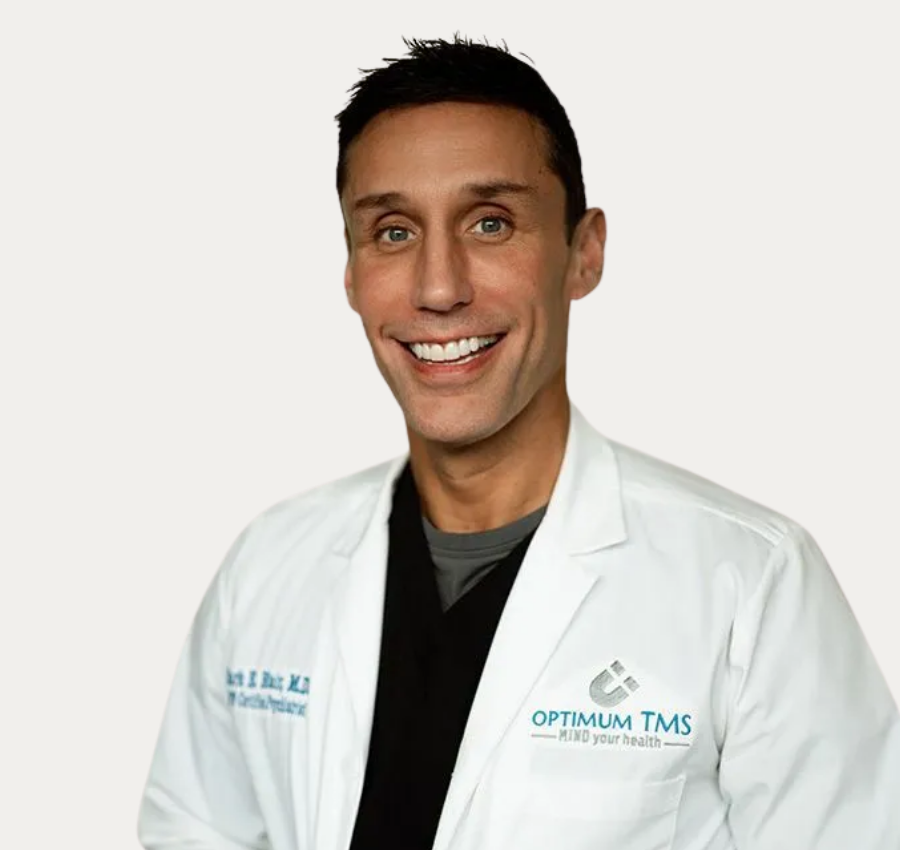
Optimum is led by Dr. Mark Blair, an ABPN board-certified psychiatrist with over 24 years in practice. He's a US Air Force veteran, founded Optimum TMS in 2017, and personally oversees every patient's treatment plan. Initial consultations are conducted by Dr. Blair or one of our psychiatric nurse practitioners.
Hear from our patients
Real reviews from real patients.
65+ Five Star Google Reviews →

Find Out If Spravato Is Right For You
Start with the 90-second check - no obligation.
Prefer to phone?
614-933-4200