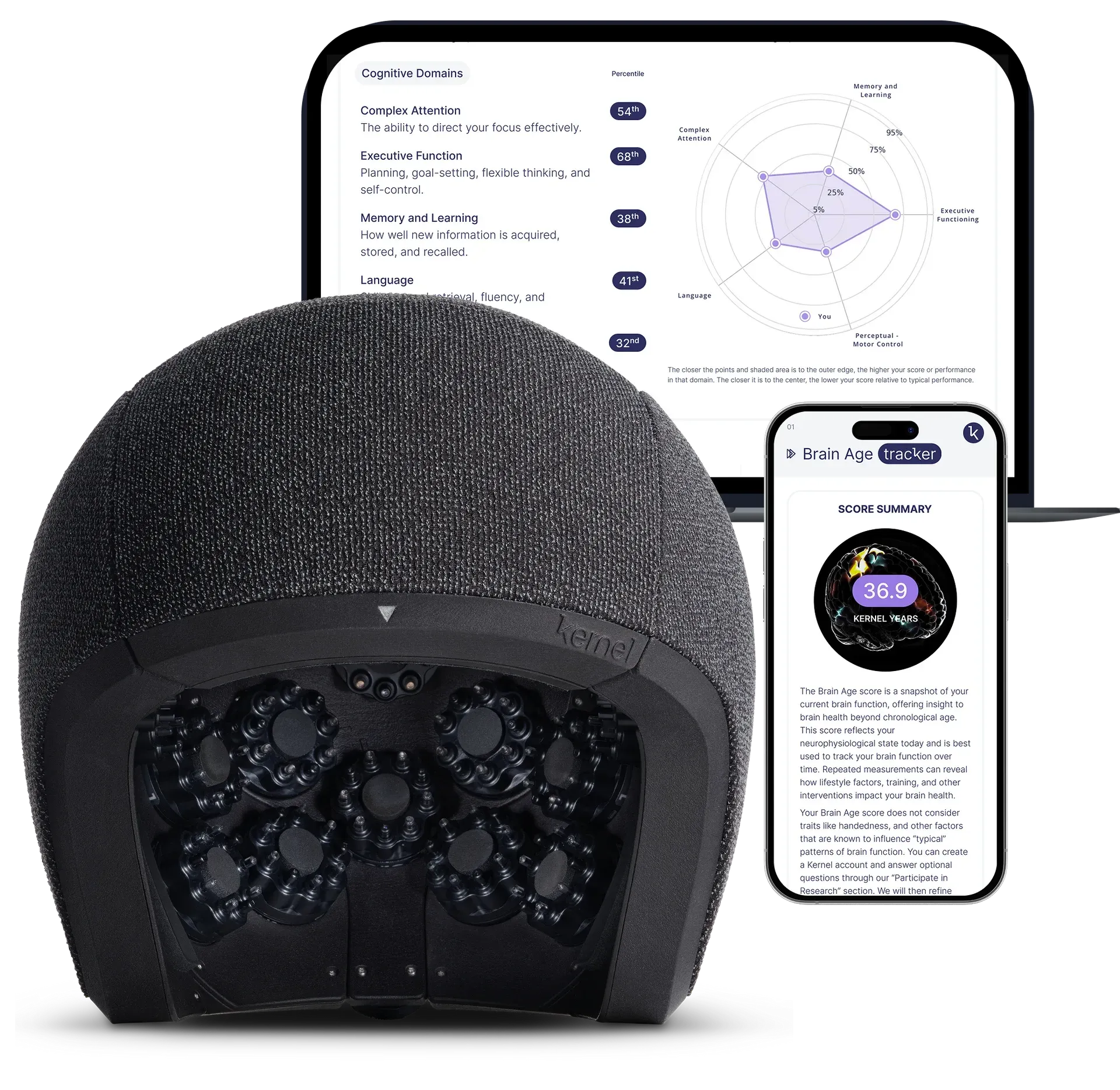
A Snapshot of How Your Brain is Doing Today.
BrainAge uses the Kernel Flow headset to measure your brain activity in seven minutes - and returns a score that compares your brain function to age-matched norms. Not a diagnosis. A wellness tool.
Ask us anything

Why people get one
Four reasons people walk in for a BrainAge scan.
There's no clinical qualification - anyone can book a scan. People come for different reasons, often more than one at a time.
What it is
A light-based brain scan.
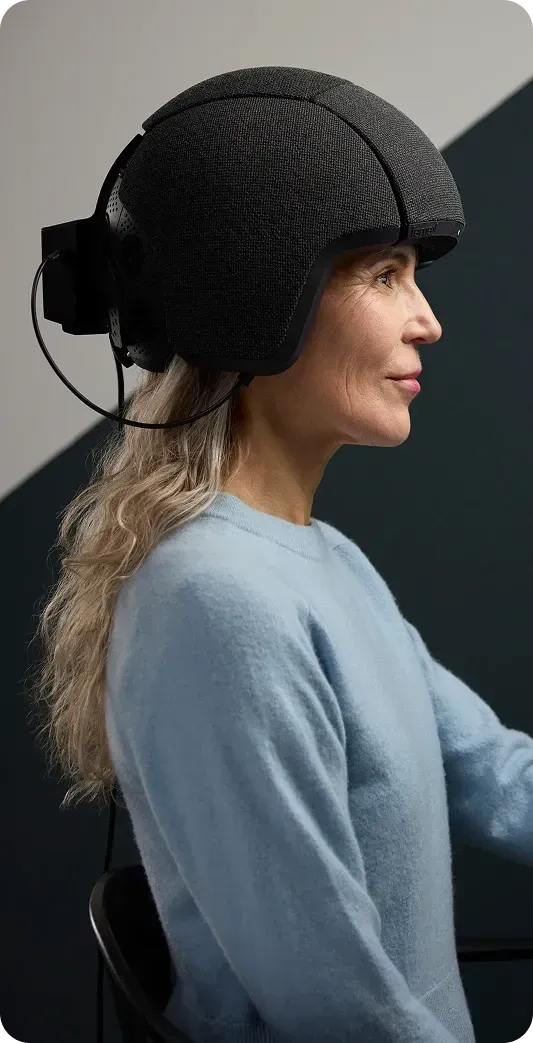
We use the Kernel Flow - a wearable headset that uses near-infrared light to measure blood flow and activity across your brain. No radiation, no needles, no claustrophobic tube. You sit upright in a chair and wear the headset for about seven minutes while it records your brain at rest - no tasks, no stimuli, just baseline neurophysiology.
The score is generated from 187 characteristics of your brain function: connectivity between regions, slow activity patterns, tissue oxygenation, and physiological signals like heart rate variability. Kernel's model compares your measurements to a reference dataset of over 375 participants and returns a single number - your BrainAge.
BrainAge is a wellness tool, not a medical test. It's repeatable - scan again in three months, six months, a year, and you'll see how your numbers shift. The underlying TD-fNIRS technology has peer-reviewed validation; the BrainAge scoring model itself has a mean absolute error of about 8.5 years. Good enough to track meaningful changes over time, not precise enough to diagnose any condition.
Your appointment
From check-in to score, in 30 minutes.
The scan - about 7 minutes
You sit in a comfortable chair. We fit the Kernel Flow headset (it looks like a bicycle helmet). The device runs a series of brief cognitive tasks - looking at a screen, responding to simple prompts - while it measures activity across your cortex. No needles, no injections, no claustrophobic enclosure.
Your score and report
Your BrainAge score and cognitive domain percentiles are processed by Kernel and emailed to you, usually within a few days. The report shows your overall score, your domain-by-domain breakdown, and how those numbers compare to age-matched reference data.
Want to track over time?
BrainAge is repeatable - many people scan every few months to track changes through treatment, lifestyle work, or wellness experimentation. Each scan is $50; we keep your history on file so the trend is easy to read.
Your first visit, start to finish
What you'll know after the scan.
You'll get: a BrainAge score that compares your measured brain function to age-matched norms. The score is derived from 187 brain characteristics including functional connectivity between regions, slow activity patterns, tissue oxygenation, and physiological signals like heart rate variability. Scan again in three or six months and you'll see how the numbers have shifted.
You won't get: a diagnosis. BrainAge cannot tell you whether you have depression, anxiety, ADHD, dementia, or any other clinical condition. It can't predict who will respond to TMS or any specific treatment. Anyone selling it as a diagnostic test is overstating what the technology can do.
The honest middle: a BrainAge score is a real measurement of brain function backed by peer-reviewed science. It's also one data point - useful as a baseline, useful as a tracking tool, not useful as a substitute for clinical evaluation if you have actual concerns about your mental health.
Cost
Fifty dollars, paid at check-in.
BrainAge isn't a clinical test, so it isn't billed through insurance. The price is flat and the same for everyone - no consultation fee, no add-ons, no follow-up charges unless you want a repeat scan later.
Single BrainAge scan
Paid at check-in. Credit card or check accepted.
WHAT'S INCLUDED
Good to know
No insurance billing. BrainAge is a wellness service, not a medical test.
No referral needed. Anyone can book a scan.
Repeat scans are $50 each - most people who track over time scan every three to six months.
If you're combining a BrainAge baseline with a TMS or Spravato consultation, ask our team about scheduling them together.
A note on insurance: BrainAge is an exploratory wellness tool, not a billable medical service. Commercial and government insurers don't cover it, and we don't submit it for reimbursement. The $50 price is flat.
Why have Optimum administer it
A clinical setting for an exploratory tool.
Kernel partners with clinics across the US. What you get at Optimum that you don't always get elsewhere.
Run by a clinic with a board-certified psychiatrist on site
Honest framing - scan presented as wellness tool, not diagnosis
Flat $50 price, no consultation fee or upsells attached
If results raise clinical concerns, a psychiatrist is right here
Can be scheduled alongside a TMS or Spravato consultation
Scan history kept on file for easy tracking over time

Typical Clinic
✕
✕
✕
✕
✕
✕
What You're Probably Wondering
Straight Answers to the Questions We Hear Most.
Is a BrainAge scan a medical test?
No. BrainAge is an exploratory wellness tool. It produces a measurement of your brain function and compares it to age-matched norms, but it doesn't diagnose any medical condition, predict any disease, or replace a clinical evaluation. If you have a clinical concern about your mental health or cognition, a BrainAge scan is not the right starting point — see a psychiatrist or neurologist first.
How does the Kernel Flow headset work?
The device uses time-domain functional near-infrared spectroscopy (TD-fNIRS) — near-infrared light shone through the scalp to measure blood flow and oxygenation across the cortex. Kernel's machine-learning model processes 187 characteristics of your brain activity to generate your BrainAge score. No radiation, no needles, no enclosed space. The underlying TD-fNIRS technology has peer-reviewed validation; Kernel's specific BrainAge scoring publication is in preparation.
What if my score is "older" than my chronological age?
It happens, and it doesn't automatically mean anything is wrong. Two technical facts worth knowing: the BrainAge model has a mean absolute error of about 8.5 years, and it's known to skew older for younger participants and younger for older ones — a documented limitation across all current functional brain age models. So a score four or five years off your chronological age sits within normal model variability, not a signal of anything specific. Beyond the math, ordinary day-to-day factors — stress, sleep, illness, medication — can move the number too. A single scan is one data point. If a number is meaningfully concerning to you, the next step isn't another scan; it's a conversation with a clinician. We have one on-site.
Can I use a BrainAge scan to track TMS or Spravato progress?
Many of our patients do. Common pattern: scan before starting a treatment course, scan again after the course ends, and a third time three to six months later. Each scan is $50. We keep your history on file. Note that BrainAge wasn't designed specifically to measure TMS response — your symptom improvement, tracked by standard clinical scales, is the more important measure.
How long does it take to get my results?
The scan itself takes about seven minutes. Results are processed by Kernel and emailed to you, usually within a few days. The report includes your overall BrainAge score, your five domain percentiles, and a brief plain-language explanation of what the numbers mean.
Why isn't this covered by insurance?
BrainAge isn't a billable medical service. It's a wellness measurement, not a clinical diagnostic. Commercial and government insurers don't cover wellness scans, and we don't submit them for reimbursement. The flat $50 price is what you pay.
Are there any safety concerns?
Kernel Flow uses near-infrared light at intensities consistent with established fNIRS research and consumer applications. No radiation, no contraindications around metal implants like with MRI, no claustrophobic enclosure. The device is comfortable to wear for the seven-minute scan duration. There are no recovery requirements — you walk in, scan, and leave.
Who runs the clinic?
Optimum is led by Dr. Mark Blair, an ABPN board-certified psychiatrist with over 24 years in practice. He's a US Air Force veteran, founded Optimum TMS in 2017, and personally oversees clinical operations. For BrainAge specifically, scans are administered by trained staff; results that raise clinical concerns can be reviewed with Dr. Blair or one of our psychiatric nurse practitioners.
Hear from our patients
Real reviews from real patients.
65+ Five Star Google Reviews →